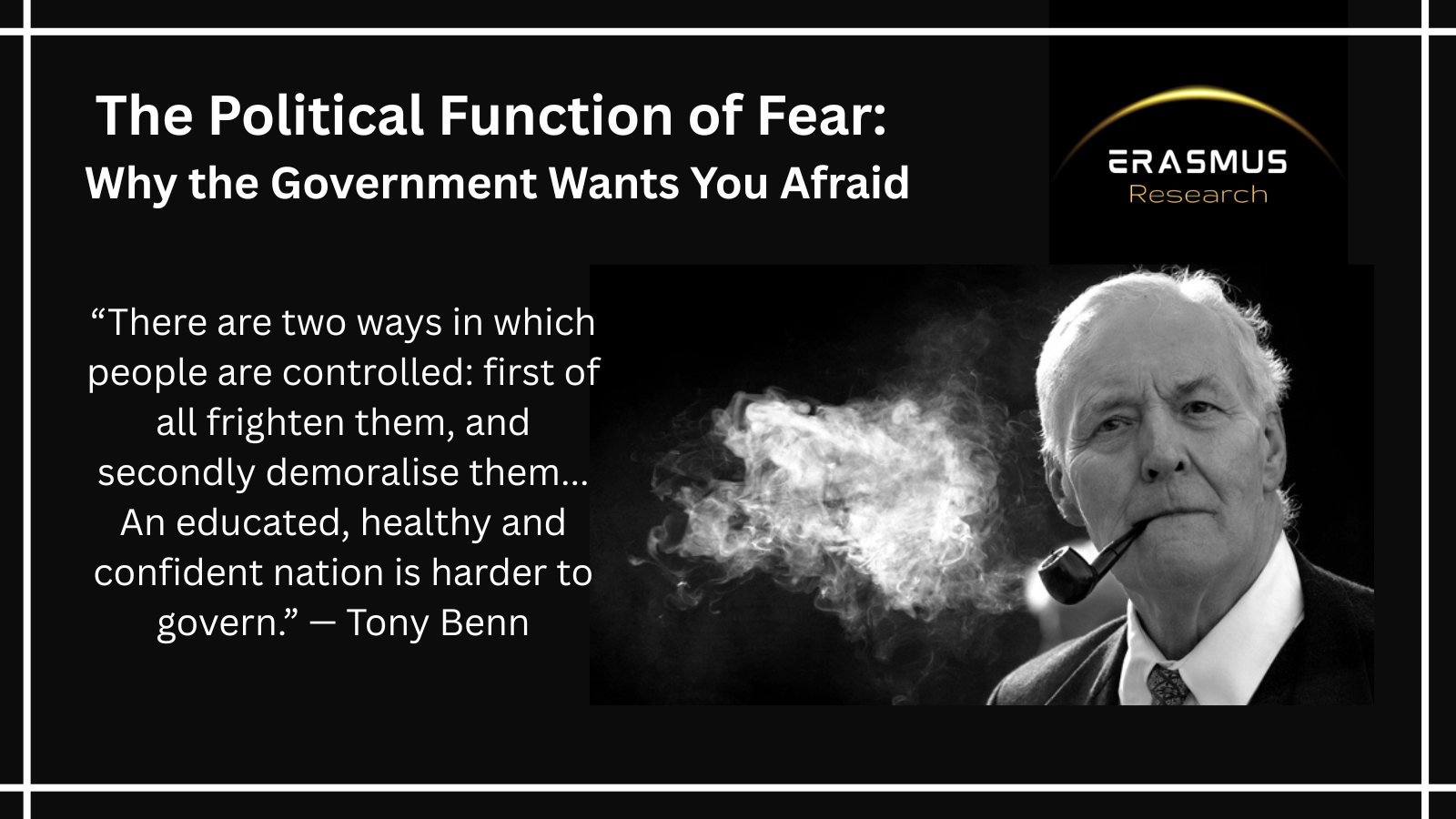
“There are two ways in which people are controlled: first of all frighten them, and secondly demoralise them… An educated, healthy and confident nation is harder to govern.” — Tony Benn
Tony Benn saw it clearly: fear and despair are not side effects of authoritarian rule — they are its central pillars. In the UK today, fear is not a response to real danger. It is a state-sponsored project.
We are living through a deliberate campaign of psychological manipulation. The government is bombarding the public with Cold War-style panic over foreign “enemies” — Russia, China, cyberattacks, border threats, while transforming billions of pounds of public money into the private profits of those who own the military-industrial complex. Mobile phone alerts simulate war-time conditions. Expect these phone alarms to become a regular feature of daily life as the UK moves towards a ‘wartime-footing’. Yet the war being waged is not by a foreign power. It is being waged at home: against the working class, the sick, the poor, and the marginalised.
As food banks multiply and homelessness soars, the state is gutting what remains of the welfare system. These so-called “reforms” will devastate disabled people, the long-term ill, and the unemployed. At the exact same time, defence spending is set to double to an estimated £120 billion. Ask yourself: who benefits from that “investment”? Not ordinary people. Weapons manufacturers, private contractors, and shareholders do. Fear isn’t just a distraction; it’s a political commodity.
Fear as Political Strategy
In Fear of Freedom (1941), Erich Fromm argued that fear is not just an emotion — it is a powerful political tool. When fear takes hold, people surrender their liberty not because they are coerced, but because they are conditioned to believe that freedom is dangerous and order is safe. That, of course, is precisely the point. When people are struggling to afford food, pay rent, or see a doctor, they are consumed by survival. They do not organise. They do not rebel. They do not ask why billionaires profit while basic needs go unmet.
Fear is the smokescreen behind which injustice thrives.
This is why governments deliberately cultivate fear. It is not a side effect of political failure, it is a mechanism of control. By creating a culture of anxiety and uncertainty, they convert citizens into subjects. Terrified people don’t mobilise. They don’t strike, occupy, or resist. They retreat. They obey. They accept mass surveillance under the guise of “national security.” They tolerate racist immigration raids, framed as “public protection.” They watch as anti-trade union laws are passed, sold to them as safeguards against “disruption.”
The underlying message is brutally clear: your safety depends on your submission. Rights become privileges. Protections become punishments. Democratic participation is replaced by managed compliance. The social contract is not torn up. It is rewritten under duress.
A frightened public becomes a governable public. And that is no accident. It is a political strategy.
Demoralisation as Social Control
The second tool of control — demoralisation — is even more insidious. It doesn’t just frighten people. It robs them of hope.
You’re not poor because wages are suppressed, you’re poor because you’re lazy. You’re not sick because the NHS has been gutted, you’re sick because you’re weak. You’re not unemployed because of structural collapse, you’re a “scrounger,” a burden. These narratives are peddled relentlessly through the media, the benefits system, and the punishment bureaucracy. They individualise structural problems, and disincentivise collective action. They turn systemic violence into personal failure.
The contemporary political mantra continues to resound. “Everything is shit. It’s getting worse year on year, day-by-day, and there’s absolutely nothing anyone can do about it”.
The deliberate degradation of public confidence is not accidental. It is a tool of domination. A confident, politically conscious population would not tolerate being ruled by a millionaire funded cabinet waging austerity while cutting tax for billionaires. So confidence itself must be crushed, through hostile policies, dehumanising services, digital surveillance, authoritarian policing, algorithmic cruelty, and a culture of shame.
The Authoritarian Drive
What we are witnessing is not the return of authoritarianism. It never left. It simply changes costume. Today, authoritarianism wears a suit and sits on the BBC Question Time panel. It wears the mask of “national security” while criminalising dissent, trade unionism, and protest. It wears the uniform of law and order while imposing curfews on communities, spying on children in schools, and turning neighbourhoods into open-air carceral zones for those on the margins. It polices political thought crime through criminalising dissent. People become too frightened to voice their concerns, to oppose genocide and war crimes, to defend the planet against the ravages of unfettered capital. The cost of having to carry a criminal record through a lifetime of disclosure checks that are designed to weed out those who refuse to comply is, all too often, too high to countenance. Some brave souls do. Many of them are languishing in prison as a stark reminder that dissent will not be tolerated. They become the ‘example’ that the state hopes will deter future attempts to resist.
No More Compliance
Fear is not a glitch in the system. It is the system. A tool to manufacture compliance, to stamp out hope, to kill solidarity.
But it doesn’t have to be this way. The true origins of fear can be exposed. Demoralisation can be resisted. When people reconnect, in struggle, in community, in shared rage, they become dangerous again. That’s why governments fear solidarity, and have, since Thatcher, been effectively destroying communities in favour of individualism, consumerism and the cult of the entrepreneur. The reason the state has for decades deployed undercover police officers to infiltrate trade unions, political groups, animal rights and environmental activists is because it is terrified of the latent power populations possess. Because solidarity makes power visible, and thus contestable. Those who have appropriated the levers of state for their own ends know this. On one hand they are terrified of people power. They know its potential. They know their history. On the other hand, they also know that revolutions can be averted and guillotines can be evaded. Create a frightened and demoralised population and the world, with all its potential for profit, remains safely in their hands.
So, in a nod to the late great Tony Benn, the next time they tell you to be afraid, ask yourself: Afraid of who? And afraid for whose benefit?