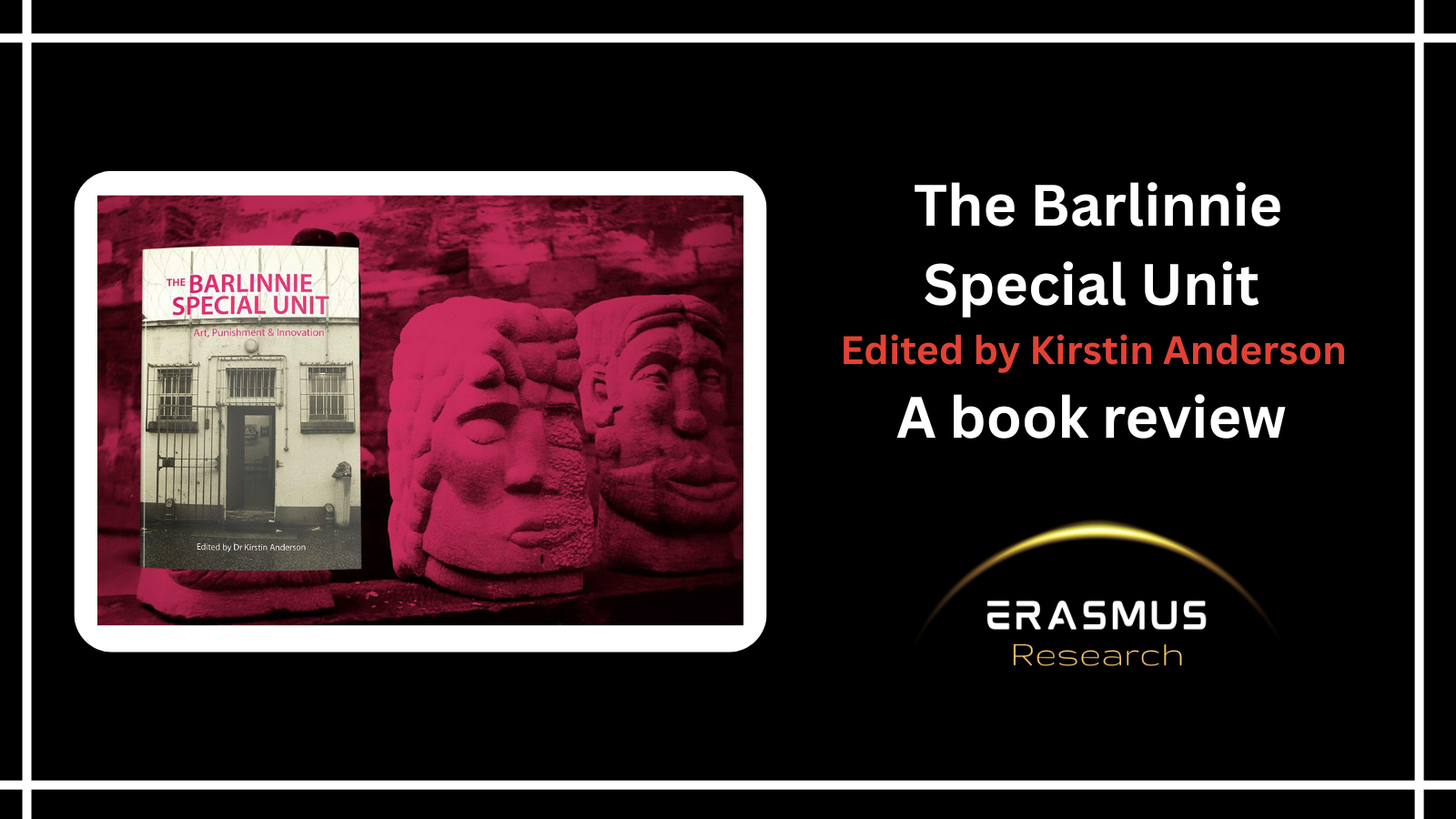
The publication of The Barlinnie Special Unit: Art, Punishment and Innovation offers a timely and significant contribution to debates on punishment, reform, and the limits of the prison as an institution. Edited by Kirstin Anderson, the volume revisits the Barlinnie Special Unit (BSU), a radical penal experiment that operated within HMP Barlinnie during the 1970s. Bringing together contributions from former prisoners, prison officers, artists, and academics, the collection constructs a rich, multi-vocal account of a regime that sought to depart fundamentally from the logics of coercion, containment, and degradation that characterise most carceral settings.
At its core, the book documents an experiment in doing prison differently. The BSU is presented as a therapeutic and participatory environment in which individuals labelled “dangerous” or “violent” were afforded an unusual degree of autonomy, responsibility, and creative expression. The unit’s emphasis on dialogue, collective decision-making, and artistic practice disrupted conventional hierarchies between staff and prisoners, prioritising the fostering of relationships rather than discipline. In this respect, the BSU stands as a powerful empirical rejoinder to dominant penal assumptions: that order must be maintained through force, that transformation is rare, and that those subject to incarceration are fundamentally resistant to change.
One of the book’s most important insights lies in the relationship it illuminates between art and justice. Anderson does not shy away from the uncomfortable question at the heart of prison arts practice: can artists and arts institutions work within prisons to create meaningful spaces of creativity and recognition without simultaneously legitimising, softening, or reproducing the harms of the prison itself? The collection never resolves this tension entirely, but its willingness to confront it directly is one of its greatest strengths. Art emerges not merely as therapy or rehabilitation, but as a profoundly humanising practice capable of restoring forms of voice, relation, and self-recognition that the prison systematically erodes.
Yet this also reveals something politically deeper. If creativity, participation, and dignity are what enable transformation, then the success of the BSU raises an unavoidable question: why should such practices be confined within prisons at all? In many respects, the book inadvertently strengthens the case for community-based alternatives to custody. The relational and creative practices celebrated within the BSU appear far more compatible with community disposals, social support, and non-carceral forms of accountability than with institutions fundamentally organised around confinement and exclusion. The closer prison comes to becoming humane, the more it begins to reveal its own redundancy.
The collection’s multi-vocal approach is one of its greatest strengths. By incorporating the perspectives of those who lived and worked within the unit, the book avoids the abstraction that often characterises academic discussions of punishment. These testimonies provide an invaluable archive of lived experience, grounding theoretical debates in concrete practices and relationships. At the same time, the diversity of voices contributes to a certain analytical unevenness. While some chapters engage critically with the broader implications of the BSU, others remain more descriptive, leaving key theoretical questions underdeveloped. For readers seeking a sustained engagement with abolitionist theory, this may be a limitation.
Nevertheless, the absence of a singular theoretical framework can also be read as an invitation. The book does not prescribe a definitive interpretation of the BSU but instead opens a space for critical reflection. In doing so, it aligns with a tradition of abolitionist thought that emphasises experimentation, plurality, and the refusal of simple solutions. The BSU is not presented as a model to be replicated wholesale, but as a provocation: a challenge to the taken-for-granted assumptions that underpin contemporary penal policy.
For scholars, practitioners, and activists concerned with the future of punishment, this volume offers both a resource and a warning. It provides concrete evidence that more humane and relational forms of engagement are possible, even within the confines of the prison estate. At the same time, it underscores the limitations of pursuing such change without confronting the broader social and political conditions that give rise to incarceration. The challenge, as the book implicitly suggests, is not simply to make prison better, but to question whether it should exist at all.
In this respect, the enduring value of this book, The Barlinnie Special Unit, lies in its capacity to unsettle. It compels readers to confront the uncomfortable possibility that the most humane version of prison may still fall short of justice. For abolitionists, this is not a reason to dismiss the experiment, but to build upon its insights: to ask how the relational, creative, and participatory practices documented within the BSU might be extended beyond prison walls rather than confined within them.
Conclusion – What is prison for?
Ultimately, The Barlinnie Special Unit is often read as evidence that prison can be done better. That is true, as far as it goes. But read more critically, it makes a more troubling point: even when prison is done “well,” it runs up against a hard limit. The problem is not simply the institution’s internal practices, but the wider social and political demand that punishment must hurt, must endure, must persist.
The Special Unit showed that people can change when they are treated as human. Its closure showed that acknowledgement of this humanity, by and within, institutions is politically fragile. And the post-Unit lives of those who passed through it, including that of Jimmy Boyle, demonstrate that even profound transformation does not dissolve the mark of the system. It travels. It follows. It fixes. It also fixates.
Perhaps this is the book’s deepest contribution. By foregrounding art, creativity, and relationality, it forces us to confront a question that reaches beyond prison reform itself: if these are the conditions under which people flourish, why organise them through institutions of confinement at all? The more convincingly the BSU demonstrates the value of creative and relational practice, the more it strengthens the argument for responses located outside the prison estate. What emerges most clearly from the book is not the necessity of better prisons, but the possibility of shrinking the space prison occupies within social life.
If prison were genuinely about rehabilitation, the Special Unit would have been expanded, not dismantled. If society were genuinely committed to reintegration, figures like Boyle would not have had to leave Scotland in order to live. The fact that neither of these things happened tells us something far more important than any policy statement. It tells us what prison is for.
And what it is for, in practice, is not transformation, not reintegration but the production of distance; not justice but the maintenance of a social order in which some lives remain permanently diminished. If that is the reality, and this book – drawing on the legacy of the BSU – strongly suggests that it is, then the lesson is not that we need better prisons. It is that we need to think seriously about whether we need prisons at all.
This is a deeply enlightening, inspiring, and intellectually courageous collection, and we highly recommend it.