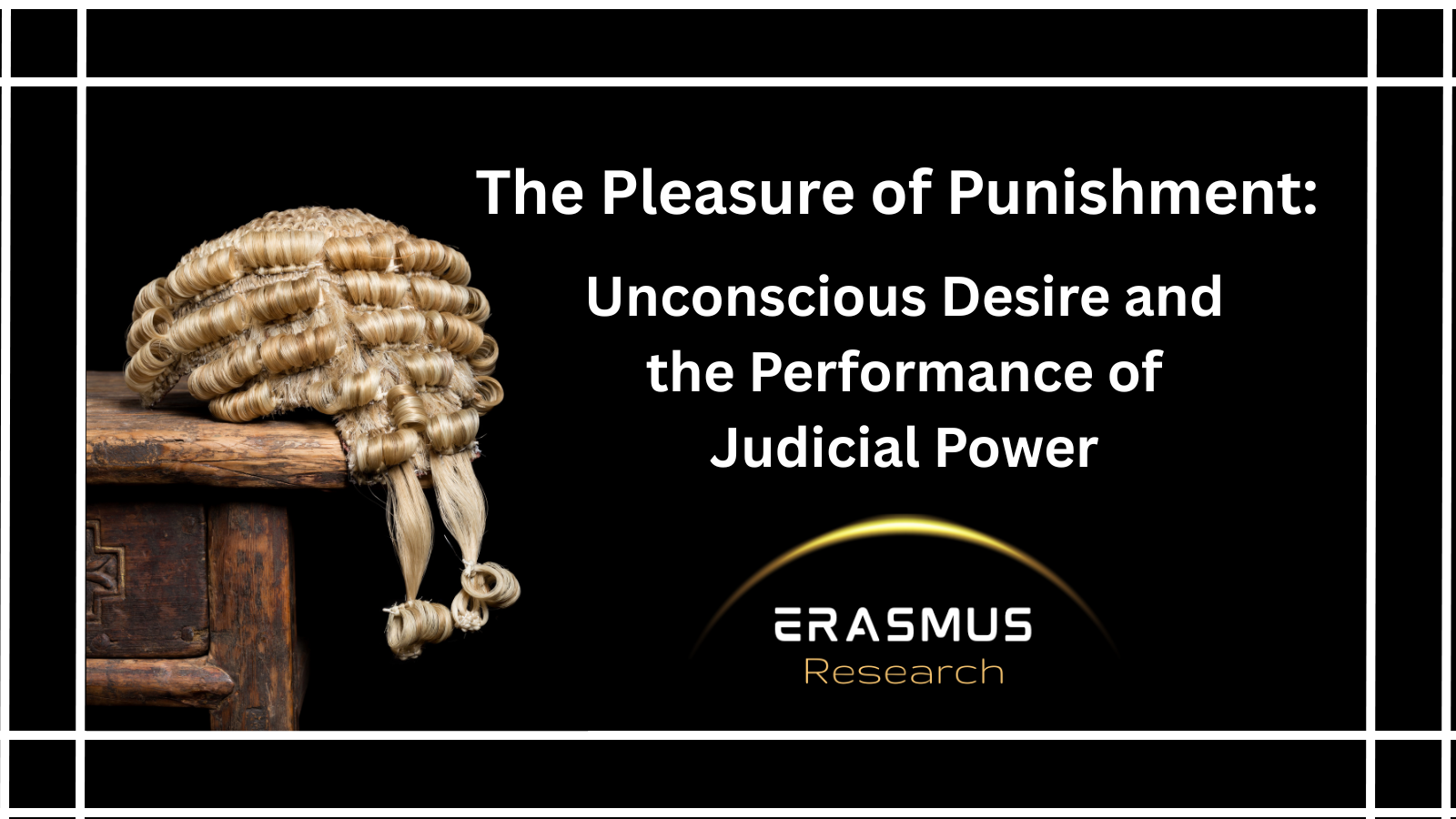
The punishment system, far from preventing harm, often exacerbates it. Despite efforts in Scotland and elsewhere to reduce prison populations, judges and sheriffs persist in handing down custodial sentences, seemingly immune to the mounting evidence that incarceration fails as a deterrent. From a utilitarian standpoint, this obsession with punishment is irrational. Yet, when viewed through a philosophical and psychoanalytic lens, it becomes clear that the judiciary’s commitment to imprisonment is not merely about justice but about something deeper—something tied to power, pleasure, and the unconscious gratification of control.
The Myth of Punishment as a Rational or Utilitarian Tool
It is evident to any rational observer that punishment does not achieve the outcomes its proponents claim. The idea that incarceration deters crime is simply not supported by empirical evidence. Countries with the harshest penal systems often have high recidivism rates, while those with more rehabilitative approaches see lower rates of reoffending. The notion that punishment provides justice to victims or protects society is similarly flawed; prisons do not prevent crime but rather serve as warehouses for individuals whom society has failed long before their conviction. The very premise that punitive measures create order or safety collapses under scrutiny—if incarceration worked as a deterrent, we would not see ever-rising prison populations. Instead, we see a system that perpetuates harm, entrenching social inequalities while failing to address the root causes of ‘crime’. If punishment does not serve a logical or utilitarian function, then why does it persist? The answer lies in the deep psychological and philosophical dimensions of power, authority, and pleasure.
If punishment fails to function as a deterrent, fails to protect society, and fails to deliver justice in any meaningful or consistent way, then we must ask what it does do—and whom it truly serves. The persistence of punitive systems, despite their demonstrable failures, suggests that punishment fulfills needs beyond the practical or the legal. It is here that we must move beyond utilitarian frameworks and turn to thinkers who have interrogated the deeper psychological, philosophical, and symbolic dimensions of punishment. These perspectives reveal that the courtroom may be less a site of rational decision-making than a stage for the performance of dominance, desire, and control. To understand the true function of punishment, we must engage with those who have exposed its hidden logics and darker gratifications.
Nietzsche and the Will to Power: The Judiciary as Masters of Suffering
Friedrich Nietzsche’s On the Genealogy of Morality offers a framework for understanding punishment as an expression of power rather than justice. Nietzsche argues that punishment originated as a means of satisfying the creditor’s desire for cruelty, rather than reforming the debtor. In this light, judges and sheriffs—positioned as moral arbiters—may not merely be executing the law but are actively indulging in an expression of power over the vulnerable. The courtroom, in this reading, is not just a site of justice but a theatre of dominance.
Freud and the Unconscious Gratification of Punishment
Freud’s psychoanalytic theory suggests that even in the most rational of institutions, unconscious drives operate beneath the surface. Judges and sheriffs act as the superego, enforcing societal norms, but their administration of punishment may not be purely rational. Freud’s theory of the pleasure principle suggests that even acts of discipline carry an element of libidinal enjoyment. Punishment, under this framework, becomes not merely a tool of justice but a space where power, repression, and unconscious satisfaction collide.
Foucault and the Performance of Disciplinary Power
Michel Foucault’s Discipline and Punish reveals how punishment is not just about retribution but about the performance of state power. Judges and sheriffs do not merely punish individuals; they define and categorize them. The courtroom becomes a stage where authority is reaffirmed, and the judge, in pronouncing a sentence, reinforces the legitimacy of the state’s control. Incarceration, despite its proven failures, persists because it serves as a ritualistic display of state dominance.
Lacan and the Concept of Jouissance: The Pleasure Beyond Reason
Jacques Lacan’s concept of jouissance—a form of excessive pleasure linked with suffering—offers a compelling explanation for why the judiciary continues to impose harsh sentences despite clear evidence of their ineffectiveness. The pleasure derived from punishment is not merely rational or conscious but operates at a deeper, more unsettling level. Judges and sheriffs, in exercising their authority, may experience a perverse satisfaction in the act of sentencing, one that goes beyond duty and enters the realm of unconscious enjoyment.
Bataille and the Eroticism of Authority
Georges Bataille’s work on transgression and power further complicates our understanding of punishment. Bataille argues that power and eroticism are intimately connected, and acts of control—including punishment—carry a transgressive pleasure. The judiciary, while maintaining a facade of neutrality, may be engaging in an exercise of authority that is not just administrative but viscerally gratifying.
Conclusion: The Judiciary’s Perverse Pleasure in Punishment
Despite mounting evidence that imprisonment is ineffective and often counterproductive, judges and sheriffs persist in their punitive instincts. When examined through Nietzsche, Freud, Foucault, Lacan, and Bataille, this persistence appears less as a failure of logic and more as a function of power and unconscious gratification. Punishment, rather than being a rational tool of justice, becomes an institutionalized performance of dominance—one in which those administering the sentences may derive a secret, perverse pleasure from their control over the condemned. Until we confront these deeper dynamics, the cycle of incarceration will continue, not because it is necessary, but because it serves the hidden desires of those who impose it.